
For decades, year-end fundraising has been the most important moment for nonprofit revenue. But in 2025, the landscape looks different. Donors are more intentional. Competition for attention is fiercer. And small nonprofits are expected to tell compelling stories across platforms, show real-time impact, and make giving frictionless.
Yet despite the challenge, small nonprofits are uniquely positioned to succeed this year. Why? Because donors now prioritise authenticity, transparency, and community engagement more than the size of an organisation.
In this guide, we’ll break down what actually works for year-end fundraising in 2025, backed by emerging trends, insights from leaders across the social sector, and performance patterns seen across community platforms like TGS (The Good Social) — a dedicated social space where nonprofits, donors, and volunteers connect through meaningful posts and impact-driven storytelling.
To keep this practical, we’ve included real examples, a 5-day rapid action plan, and links to trusted sources like HubSpot, Classy, and Hootsuite for deeper reading
Why Year-End Fundraising Has Shifted — And What Donors Expect in 2025
The donor experience today is shaped by digital behaviour, social proof, and storytelling. According to Classy’s State of Modern Philanthropy Report, 56% of donors say they are more likely to give when they see ongoing updates from an organisation. Similarly, trends from HubSpot’s storytelling research show that emotionally resonant stories outperform fact-based appeals in nearly every industry — including the social sector.
Three major shifts define 2025:
1. Donors want genuine, specific, human stories
Not big organisational overviews — but real moments:
- A family who rebuilt their life
- A volunteer sharing a personal reason for giving
- A small win in your community
- A challenge your team overcame
These real experiences create emotional trust.
2. Transparency builds credibility
Donors expect:
- Clear impact breakdowns
- Regular updates
- Honest language
- Behind-the-scenes context
Platforms like Nonprofit Tech for Good note that donors respond best to transparent communication and micro-impact reporting.
3. Community momentum influences giving
Social giving doesn’t happen in isolation. People donate when they see:
- Others supporting the cause
- Volunteers sharing content
- Organisations posting consistently on platforms they trust
This is why many nonprofits also share updates on community-focused platforms like TGS (https://thegoodsocial.ai), where donors come specifically to explore verified causes and connect with nonprofits they believe in.
What Actually Works for Year-End Fundraising in 2025 (Field-Tested Strategies)
Below are the practical strategies small nonprofits are using — proven, realistic, and aligned with donor expectations this year.
1. A Compelling Core Story Told Through Multi-Channel Posts
Your campaign needs one anchor story — a human-centred narrative that becomes the heart of all your December messaging.
This story can be reshared through:
- Social media
- Community platforms like TGS
- WhatsApp broadcast lists
- Website landing pages
When the same story is echoed consistently across channels, it builds familiarity and trust — a concept reinforced by HubSpot’s flywheel model of marketing momentum.
Nonprofit example:
A Mumbai-based children’s NGO used a single story of a young girl returning to school after a year of hardship. They shared it across email, TGS, Instagram, and volunteer WhatsApp groups. With no paid ads, they raised 22% more than the previous year.
2. A Simple, Optimised Donation Flow (Under 30 Seconds)
The best campaign fails if the donation page is confusing.
Classy’s research shows that reducing donation fields increases conversions significantly. Aim for:
- 2–3 step checkout
- Mobile-first layout
- UPI/GPay/Apple Pay
- Clear impact tiers (“₹500 = 1 nutrition kit”)
- One CTA: Give Now
Small nonprofits often underestimate how much friction costs them.
3. Short, Consistent Updates Throughout December
Not long essays — but simple, human updates:
- “Today we distributed 120 food packets”
- “A quick win from the field!”
- “Thank you to 15 donors who supported us this week”
- “We’re at 40% of our goal — here’s today’s highlight”
These work extremely well on platforms where donors seek nonprofits directly, like TGS, as well as Instagram, LinkedIn, and WhatsApp groups.
4. Social Proof and Donor Acknowledgement
People support causes they see others supporting.
Share posts that highlight:
- Donor shoutouts (with consent)
- Volunteer testimonials
- Collaborations with local businesses
- Screenshots of supportive messages
- Progress bars and check-ins
This creates community energy — something Hootsuite’s nonprofit trends emphasise as a core driver of social engagement.
5. Visuals That Show Impact — Not Perfection
In 2025, donors gravitate toward honest visuals:
- Real photos from your programs
- Team selfies while working
- Community events
- Before-and-after moments
- Infographics summarising impact
These visuals perform especially well on TGS because the audience is pre-aligned with social good content.
6. Collaboration with Micro-Communities
Small nonprofits thrive by leveraging:
- School groups
- Alumni circles
- Local collectives
- Corporate employee networks
- Citizen volunteer groups
Platforms like TGS make it easier to reach supporters who want to discover nonprofits with meaningful missions.
The 5-Day Rapid Action Plan (Small Nonprofit Edition)
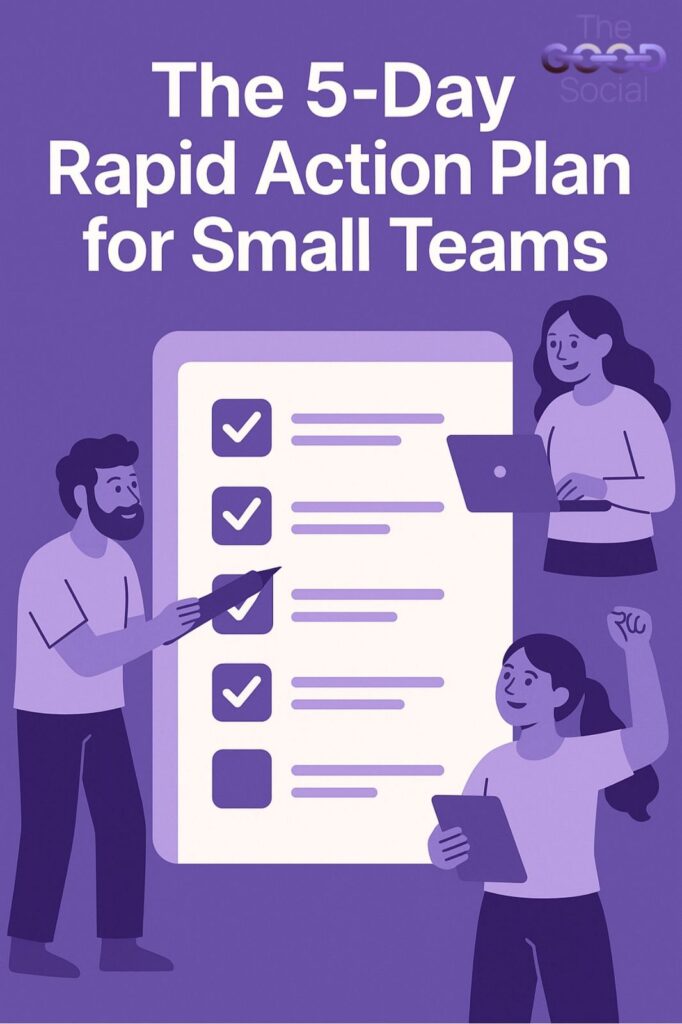
This plan is designed for small teams that need results fast.
Day 1 — Create Your Anchor Story + Campaign Message
Your story should include:
- A relatable character
- A challenge
- Your intervention
- The outcome
- A strong emotional reason to give
Use this story for all December content.
Day 2 — Build a Clean Donation Landing Page
Include:
- A single hero image
- A short headline
- Three impact tiers
- A progress bar
- A recurring giving option
Day 3 — Prepare 10 Micro-Posts for December
These can be shared on:
- WhatsApp groups
- The Good Social
Post types:
- Gratitude
- Impact moment
- Program highlight
- Team message
- Countdown to Dec 31
- Community collaboration
Day 4 — Launch Email + First Social Wave
Send:
- Email #1: Story
- Email #2: Impact tier highlight
- Post everywhere: your anchor story
- Upload on TGS for community discovery
Day 5 — Activate Your Inner Circle
Ask:
- Volunteers
- Staff
- Alumni
- Board
- Donors
- Community members
…to share your campaign directly or through platforms they use.
Your campaign now has organic visibility, credibility, and momentum.
Real Example: Simple Storytelling, Real Results
A small disability inclusion nonprofit in Bengaluru raised 37% more last December by:
- Sharing weekly updates on social
- Posting short, authentic moments on TGS
- Engaging volunteers to share keyword-rich content
- Keeping donation flows mobile-friendly
- Ending the campaign with a gratitude wave
No fancy videos.
No ad budget.
Just clear storytelling and consistent micro-updates.
Further Reading (Authoritative External Resources)
- HubSpot – Brand Storytelling Strategies
- Classy – State of Modern Philanthropy 2025
- Hootsuite – Nonprofit Social Media Trends
From One Nonprofit Champion to Another
Year-end fundraising in 2025 is about clarity, community, and connection.
Your mission deserves visibility — and your supporters are ready to give.
For more practical strategies, campaigns, and nonprofit storytelling insights, visit:
👉 https://blog.thegoodsocial.net
To build your digital presence and share posts where donors and volunteers actively discover nonprofits:
Let’s make this your most impactful year-end yet. 💙